A Beautiful Stab in the Neighborhood

Yesterday I attended my second sashiko class at Blue & White (you can read about my first class here and more about sashiko here).  I was a little hesitant to go — though I had a lovely time last month, the class is a bit expensive and the question-and-answer format is not ideal, considering I can’t ask a question in Japanese, let alone understand the response.  But I went, figuring it would be my last for a while.

When I arrived three other women were already at the table, and another followed me into the shop.  All of them seemed to know each other, and were quite lively with their greetings.  I was able to contribute a little はじめまして (nice to meet you), and we all sat down.

The class quickly devolved into a series of show-and-tells, each woman showing off her sashiko to the others.  It was fun to see all their different projects — two were working on table coverings, one was free-hand stitching a Christmas tree, and another pulled about 10 (yes, 10!) projects out of her bag.  Fortunately, complete awe is a universal language, and we all nodded in admiration as each project came to the table.  Later, the shop’s owner joined us.  She translated for me a bit, and explained the ladies were joking about some of their uneven sashiko lines — some done before nap time and others after.

As I went to leave, I gave each woman a bow and a thank you.  I’d had a lovely time yet again, and decided perhaps the class was worth the price of admission, if only to spend a few hours giggling with other 主婦 (housewives).  Then they sent me on my way — with lunch!  That’s right, one of ladies actually gave me her homemade rice and sweet potato lunch.  Perhaps she was trying to entice me back, or more likely she felt sorry for me and thought I needed a home-cooked meal.  There may have been something lost in translation, but I’m pretty sure I didn’t steal her lunch.  She gave it to me!  Whatever the case, I was completely touched, and went home feeling a little choked up.  Maybe I’ll have to check out the November class after all.

A Tokyo local and interested in the sashiko class?  They’re held monthly at Blue & White, 2-9-2 Azabu juban, Minato-ku, tel. 03 3451 0537

Crafty Pie

In the wake of my tirade pie-rade the other day, I couldn’t resist a little of this:

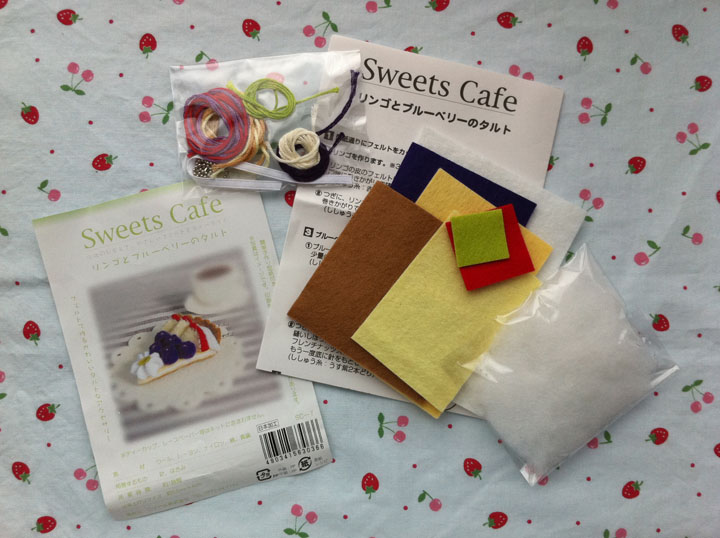
While wandering through my friendly neighborhood craft store Yuzawaya, I came across the make-cute-things-out-of-felt aisle.  Usually able to resist its powerful magnetic pull, this time I fell victim and I came home with a sweet little kit of my very own.  I blame the pie.

I haven’t yet delved into too many Japanese craft kits (and there are many! glass, wood, felt, wool, paper, plastic… hobbies are serious business) but figured I could handle this one — just cut the felt into shapes and stitch it together like in the photograph.  Right, piece of cake, er, I mean easy as pie.

I should know better than to trust my own clichés!  As anyone who has made a pie knows, pate brisee is not easy (damn you, ice cold butter chunks that make it impossible to roll you into a flat pie crust shaped circle!).  I opened the kit this morning, and the pieces are teeeny.  I don’t think I can cut them that small, let alone stitch them into something smaller.  Apparently my big Norwegian hands are not well-suited for cute felt things.

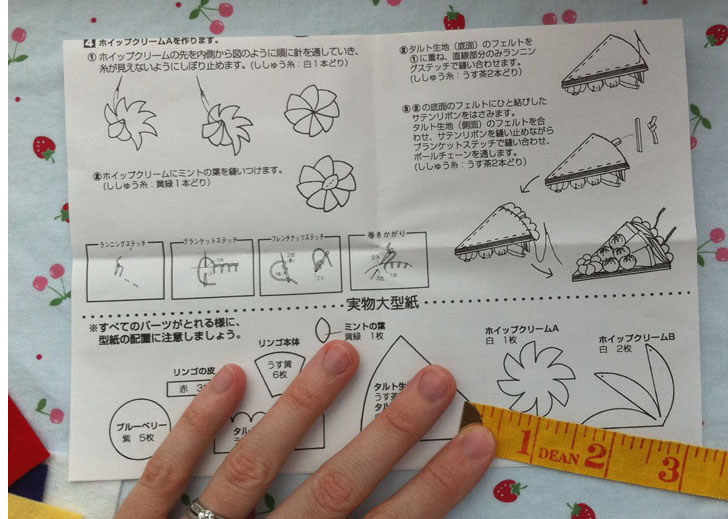
Also, I forgot that there might be directions to follow, and that they would be in Japanese.  What can I say, pie + crafts make me crazy.

Feeling Stabby – An Update

A few weeks ago I gushed about my new favorite form of needlework, sashiko.  Since then, my stabby little fingers have been busy: I finished up one project, started two more, and attended my first sashiko class.  Whew, what a busy Stab-tember!

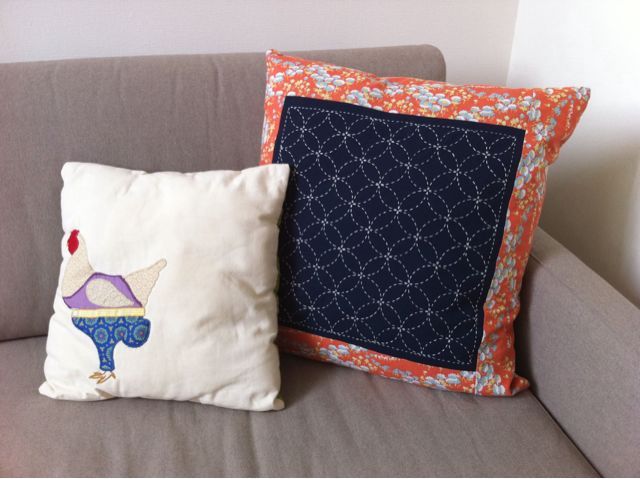
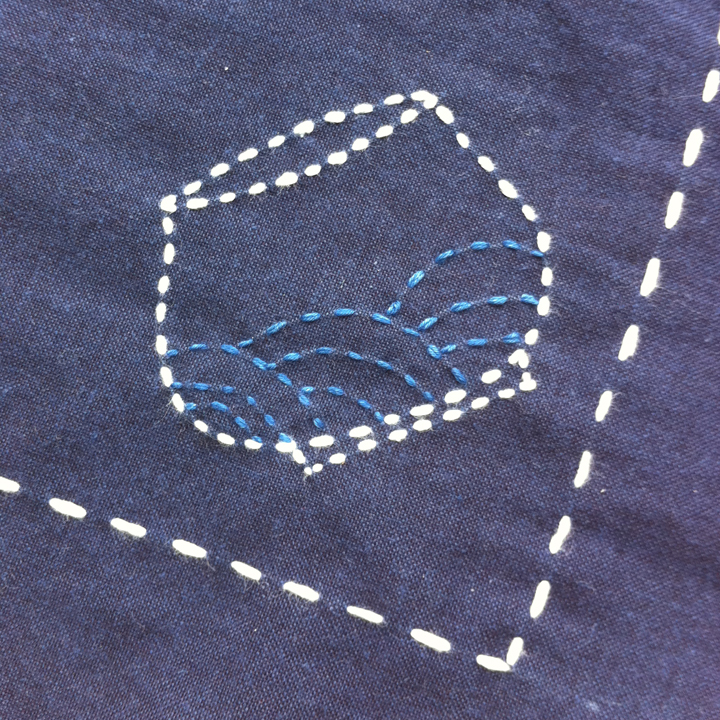
Thanks for all the great suggestions on what to do with my finished shippo tsunagi 七宝つなぎ.  I think it’s destined to become part of a bigger whole, but I don’t have the heart to hide it in a closet until then.  And so, a quick stitch into a pillow case seemed like a good interim solution.

Careful there, clothes can make things difficult for a hen.

With one finished piece under my belt, I felt pretty good about going into my first sashiko class.  And it was great!  Conducted entirely in Japanese, it was just a few women sitting around a table, with the sensei directing us individually whenever we needed help.  I spent most of my class time listening to the other women in the room chatter, and surprisingly picked up more of their conversations than I thought I could.  I guess my limited vocabulary of mostly craft terms helped me, for once.

I came home with a new project in hand, a small table covering decorated with teacups.  The biggest difference about my new project is that it is not printed directly onto the fabric, but is instead traced on using white carbon paper.  The indigo fabric and thread were also much better quality, and when I got home I discovered my fingers were a wonderful shade of blue from the dyes.

The needle is also much smaller than the one I picked up at the craft store during my first week here, though much sharper and I think perhaps I prefer it.  I signed up for the October class, so  I’ll be sure to keep you up-to-stab!

A Tokyo local and interested in the sashiko class?  They’re held monthly at Blue & White, 2-9-2 Azabu juban, Minato-ku, tel. 03 3451 0537
A Declaration of Craft

It was a busy one for me here last week.  Not only have I upped the ante on my Japanese study, I’m still trying to figure out how to do laundry/shop for groceries/live here, etc., but I also discovered two — yes, two! — new-to-me craft stores.

Now those of you who are new to the craft scene (aka, all of you who come to this blog for the food and are tricked into reading about fabric) may think all craft stores are the same.  Not so, dear friends.  Some are like warehouses where you have to dig through piles of musty fabric for a scrap of gold, and some are classy establishments, like La Droguerie.

La Droguerie is beautiful.  (No photos are allowed inside, so I snapped that shot on my way out.)  It is probably the most beautiful craft shop I’ve ever seen, and I have seen many in my short craft life.  Bobbles and buttons are kept in big glass jars on well-lit shelves, and colorful rows of ribbons hang amongst fabric and other notions.

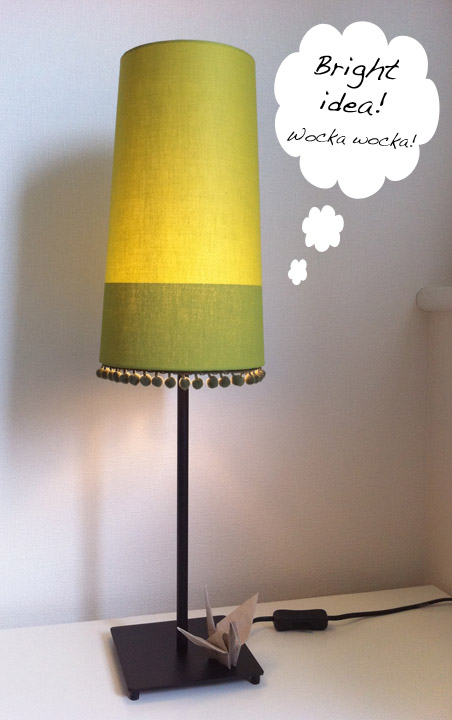
La Droguerie is a French chain that sells mainly their own brand of yarns.  I learned later that you are not supposed to rummage through the jars yourself, but rather wait for a salesperson to come over and do it for you.  Whoops.  I totally had my hands in some piles of felt.  It just couldn’t be avoided.  Also, everything was very expensive.  I wanted a tiny bit of some trim that was unpriced, and thought, “How expensive can some trim be, anyway?”  Well, expensive.  Though, now I have a mighty fine improved-upon Ikea lamp to show for it:

La Droguerie was nice to look at, though I’m not sure I need to visit it too often.  Especially because two days later, I found Yuzawaya ユザワヤ — eight buildings of crafts spread out along three city blocks.  After the excited/frantic and perhaps unintelligible text message I sent to Dan, he reminded me to breathe and eat, advice I thankfully followed or I certainly would have passed out.  In fact, as I inhaled some deep fried tofu skins (don’t cringe, it’s delicious!) while standing in an alley behind a 7-11, I realized I might indeed have a problem.  But, more on that later.

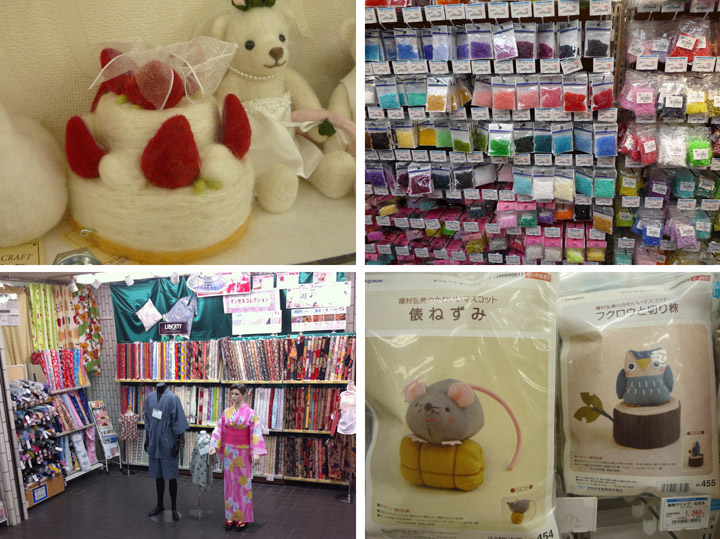
I spent a lot of time at Yuzawaya that day and only made it through 1.5 of the 8 buildings before they closed their doors for the night.  A felted wedding cake anyone?  How about an adorable DIY stuffed mouse?  Or a Hello Kitty kimono?  It could all be mine!

It was while at Yuzawaya when I realized that making things is more than just a hobby for me.  It doesn’t have to be a problem — why not embrace it?!  (Cue light bulb.) Though this Declaration of Craft will not surprise many of my friends and family, I have somehow surprised myself.  And so, I have a new focus for my time here in Tokyo — in addition to exploring a new city and learning a new language, I’ll be venturing on some other craft-related endeavors.  Huzzah!  I promise to share in due time.

For those of you interested in visiting these places yourselves:

La Droguerie Ometesando
Omotesando LH bldg 1F
4-13-9, Jingumae, Shibuya-ku, Tokyo
Ometesando station – behind Ometesando Hills

Yuzawaya ユザワヤ
4-12, Nishikamata 8-chome, Ohta-ku, Tokyo
Kamata station – take a left from the West Exit, walk under the tracks, look for signs to your right

I’m currently compiling a Tokyo craft guide, so check back for that in a few weeks.  Thanks!

I’ll Stab You.

I thought I’d reveal some of what my crafty little fingers are up to when not riding bikes through the city or sloshing through fish guts.  Three weeks of radio silence, or, shall I say cybershush? (thanks for that, spoppy!) combined with a few cross-Pacific flights, and this embroidery project didn’t stand a chance.  Honestly, it was so addictive I couldn’t put it down.

You may remember that during one of my first ventures into a craft store here in Tokyo, I emerged with some sashiko supplies.  Sashiko 刺し子 literally meaning “little stabs,” is a Japanese style of embroidery used to decoratively reinforce fabric, though nowadays I think it’s all for fun.  The pattern I picked up is called shippo tsunagi 七宝つなぎ, or seven treasures, and it was printed directly onto the fabric.  You simply follow the lines.

Sashiko needles are really long for optimum stabbing.  On the left you’ll see my regular embroidery needle, and on the right, I can’t believe I found a US quarter!

Stab the needle through the fabric, following the pattern, until you have a few stitches lined up.  Then, pull your thread through.

I found a rhythm, doing this over and over again.  Stab stab stab, pull.  The patterns look a little confusing until you break it down into small parts.  Stab stab stab, over and over again.

And voila!  So now the question is, what to do with my finished block?  I have some ideas, but I’d love to hear your suggestions.  In the meantime, I think I might have to find some more patterns.  I’m still feeling a little stabby.

Update – since posting this morning, I’ve had even more sashiko excitement!  I wandered into a store in my neighborhood (that coincidentally only sells blue and white things) and discovered they offer sashiko classes!  I immediately signed up for the next one in September.  I might also consider it language practice, since the whole class will be in Japanese… Can’t wait!

Home Sweet Home

Here it is, the long-anticipated apartment tour!  OK, maybe only long-anticipated by my mother, but nonetheless, it’s finally here for the taking.  And talk about a blank slate!

It may not look like much, but I’m pretty happy with our 39 square meters (for you kids in the USA, that’s about 420 square feet).  Come on in, let me show you around!

Tokyo apartment entry

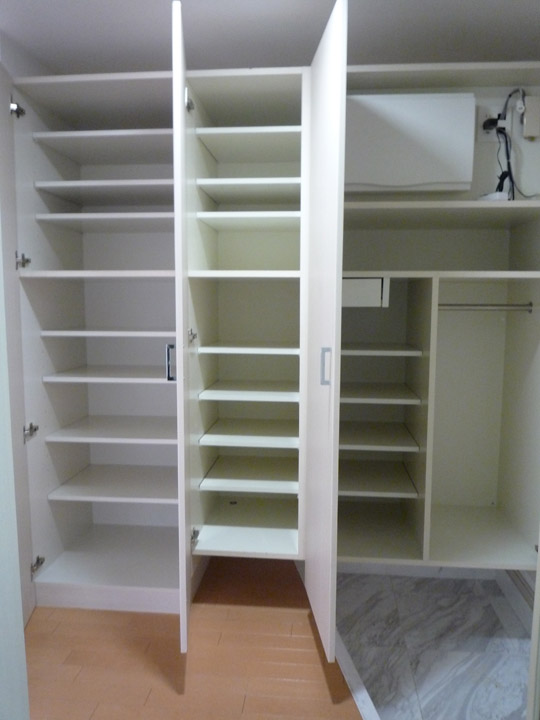
As you come in the front door, you’ll notice the little Japanese-style entry way.  The recessed floor here is called a genkan (げんかん).   Shoes off, please!  We’re digging the slipper-clad lifestyle in these parts.  You’ll also notice all the closet space:

apartment entry closet

Some of this space is used to stash shoes and umbrellas, removed while in the genkan.  Since this is most of the storage space for the apartment, I’ll be using this area as a linen closet as well.  While standing in the entry, let’s do a 180-degree turn to find ourselves peering into the bathroom:

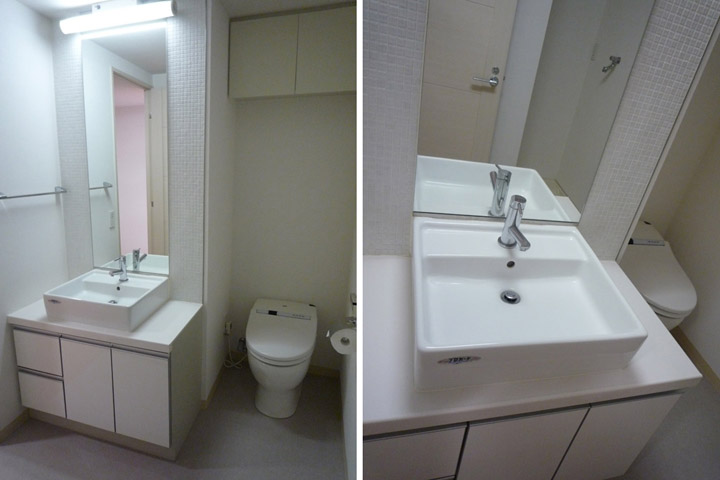
apartment bathroom

This bathroom feels gigantic.  It is both Japanese and Western styled; I like to think it is the best of both worlds.

apartment bathroom details

The cabinets and walls are pretty plain, but a nice sink and Japanese super toilet share the space.

apartment bathroom super toilet

Yup, there’s our auto flush toilet.  You can see it also has a computer console — maybe someday we’ll be brave enough to figure out what all those buttons do.

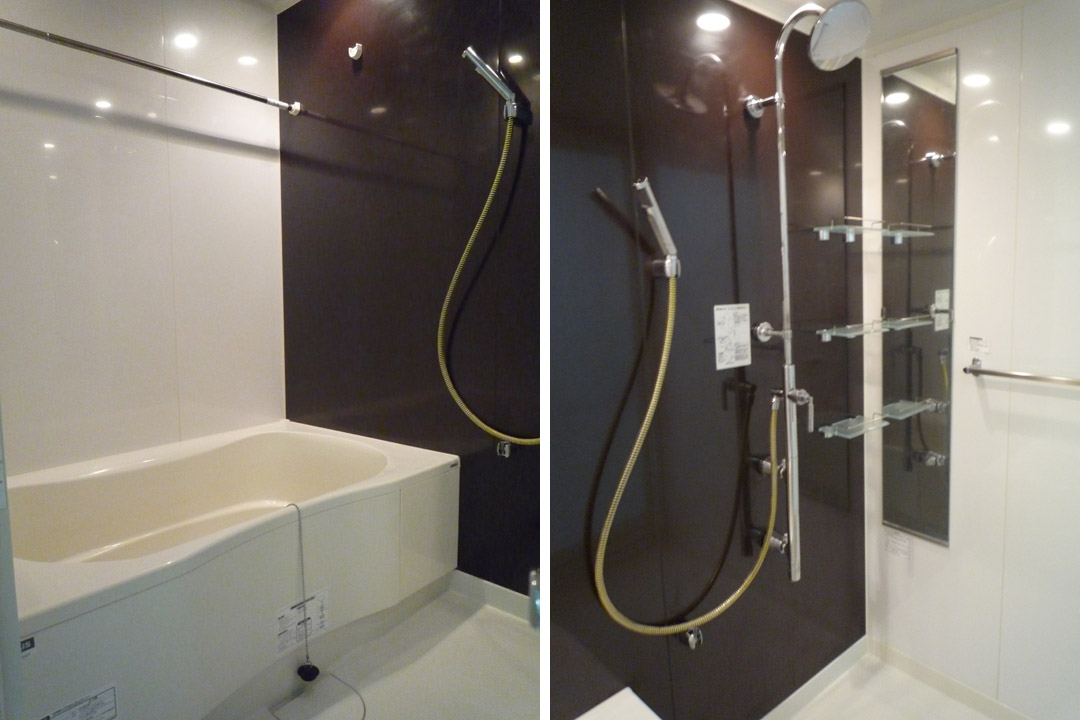
apartment bathroom shower room

Past the sink and toilet is the Japanese-style shower room.  I love the shower room.  In a Japanese home, it is customary to soap up and rinse off before you get in your tub of hot water, so the entire room is waterproof.  For me, it is more like a giant, heated shower.  You can also hang clothes to dry and run a heater, auto fill the tub (a nice little voice tells you what is happening, though I can’t yet understand her), and spray down the whole room for cleaning.  Brilliant, right?  I don’t plan on taking too many baths and am a little sad that the tub is taking up valuable square meters better served by a sofa (ok, maybe not in that exact location), but overall I can’t complain about the shower room.  Like it, like it, love love love!

apartment hall

After you step out of the entry, you get a brief view of the rest of the apartment.  To the left, the bedroom, to the right, the living room.

apartment bedroom

Attached to the bedroom there is a little balcony.  Many people in Tokyo hang their clothes and bedding out to air on nice days.  This balcony is a little on the small side, so it might be better served by some potted herbs.

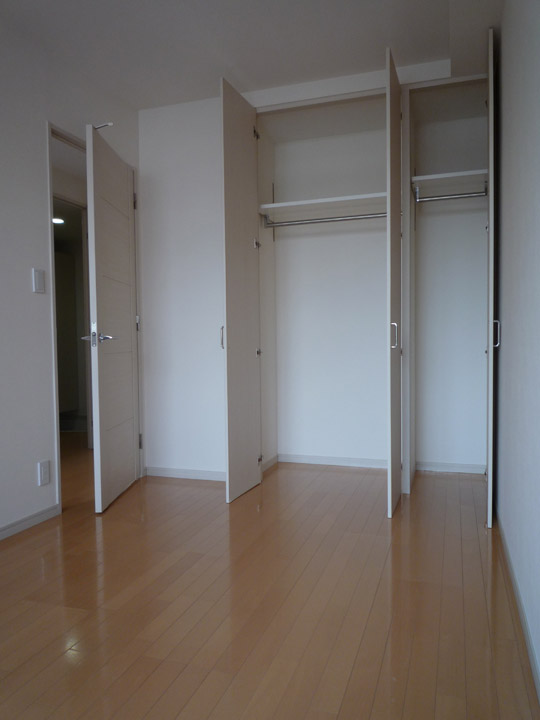
apartment bedroom closets

A reverse view of the bedroom reveals the closets.  Take a look at those beauties!  We won’t yet talk about who gets the big one…

apartment living room

Now we head back into the living room.  I love the built-in bookshelves.  Also, you can almost make out our view through the window.  Not quite as awesome as our last place on the 11th floor, but not too shabby either.  At night, we can still see Tokyo Tower in all its gaudy glory.

apartment kitchen

A reverse view of this room give us a glimpse of the kitchen (you can also see the door that separates the entry from the rest of the apartment).

apartment kitchen close up

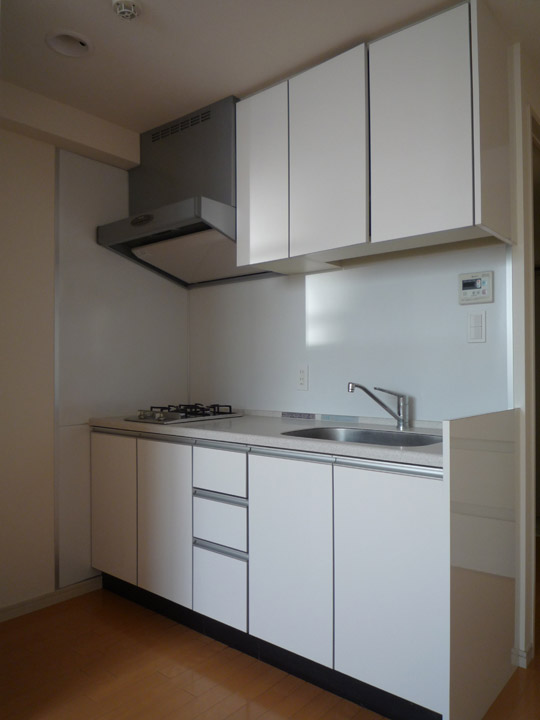
Perhaps a little boring, but nothing I can’t fix with some home-stitched linens.  And now, a view of my one disappointment…

apartment kitchen range

Look at that tiny little range!  Two burners, and no oven.  Not even a fish broiler.  There go my dreams of opening a sidewalk pie stand.  Sorry, Tokyo, your loss.

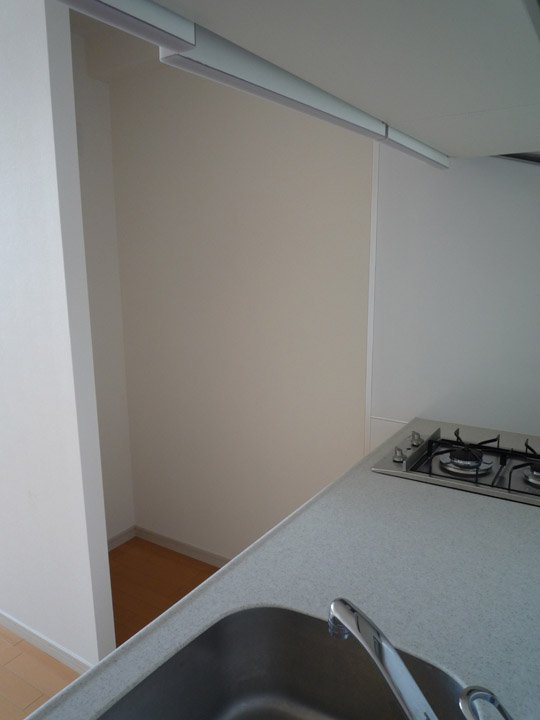
apartment kitchen refrigertor

A peek at my other kitchen challenge — in Japan, an “unfurnished” apartment really means unfurnished, no appliances included.  In this photo you can see the cubbyhole where our fridge will go, someday.

So there you go — our new tiny home in the biggest city in the world.  And really, right now, I wouldn’t have it any other way.  Just think of the time I’ll save cleaning…

On pins and needles for pins and needles

I hit the jackpot.

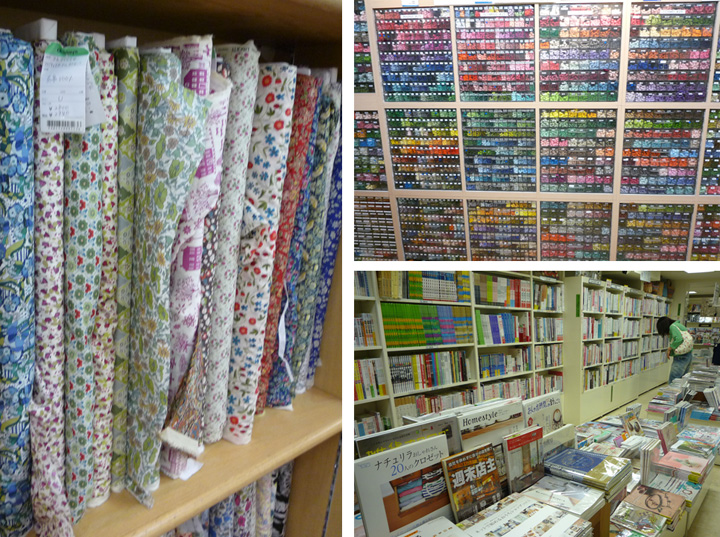
For the past week I halfheartedly sought out craft shops.  A few were smaller than I expected, and I was starting to loose a little faith in Japan’s craft craziness.  Then I found Okadaya in Shinjuku — 2 buildings with 7 floors each of so many crafts I didn’t quite know what to do with myself.  Some of the highlights:

The first photo shows one shelf of my favorite fabric, Liberty of London.  This is the usual selection you’ll find at a fabric store in the US, and Okadaya had at least 8 more shelves like this one.  The wall of embroidery floss was amazing.  The store was too small for me to get far enough from the wall to take it all in with my camera.  And finally, I discovered an entire level dedicated to craft books.  An entire level!

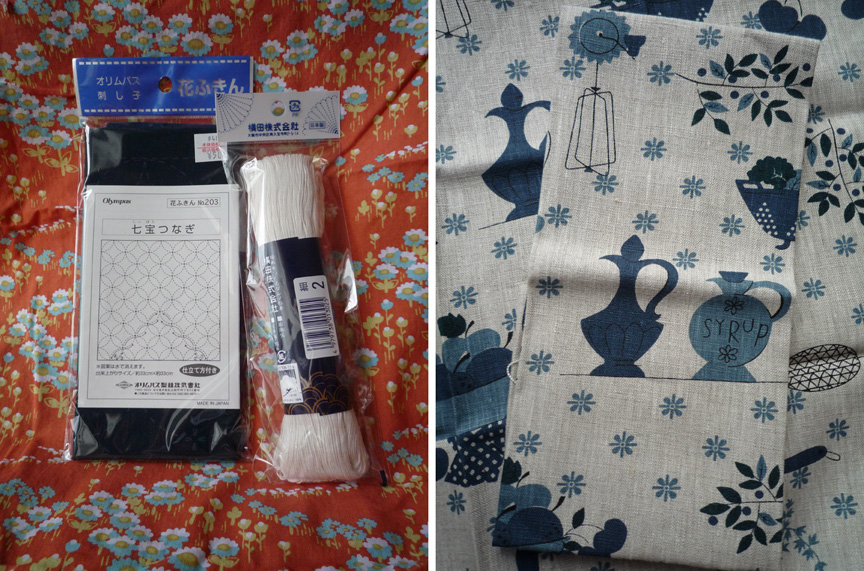
I showed incredible restraint, and left with just a few treasures:

First I found 刺し子 (sashiko, literally meaning “little stabs”), a Japanese style of embroidery.  I had read about this at Purl, and am excited to finally try it.  I also picked up a few squares of some great linen, which might find a home in my kitchen somehow.

As excited as I am about Okadaya, my next find was even greater.  Just 3 doors down, I stumbled into this place:

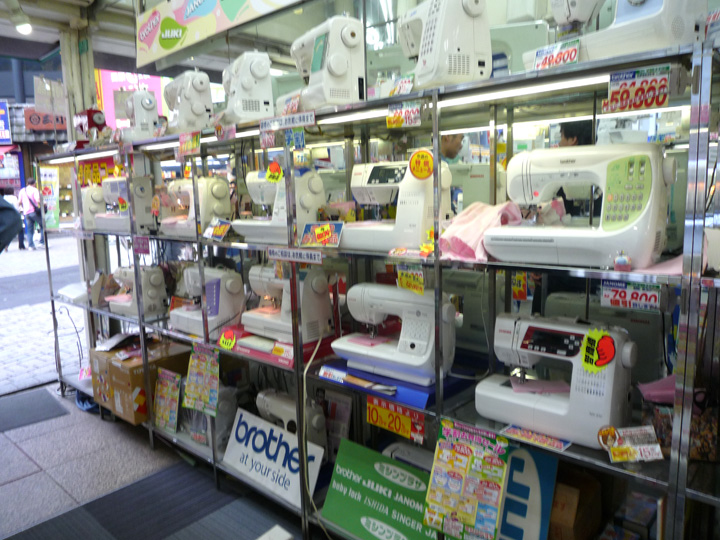
A tiny shop dedicated to nothing else but sewing machines!  It was a really small space, but probably had over 50 different machines on display.  I’ve been shopping for one (obviously) and have even learned how to ask a salesperson where to find them, so I was super pumped to find this little gem.  I definitely did not leave empty-handed…

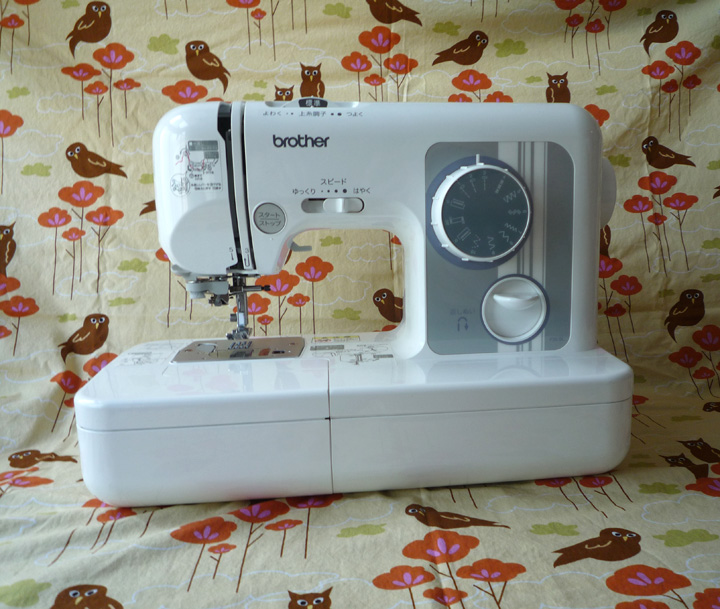
TA DA!  I am pretty excited about my Brother ELU52.  It is a small machine with basic functions, but it will keep me busy while I’m here in Japan.  Good thing I already know how to work the little guy:

You should see the instruction booklet…

“Like it, like it! Love love love!”

Last night Dan and I explored the northern part of Tokyo, beginning our promenade at the Nippori station in search of Fabric Town.  WHOA.  This place is my dream come true — fabric store upon notion shop upon specialty lace shop upon fabric store line a full city block; I vow to visit again with a better purpose and more projects in mind.

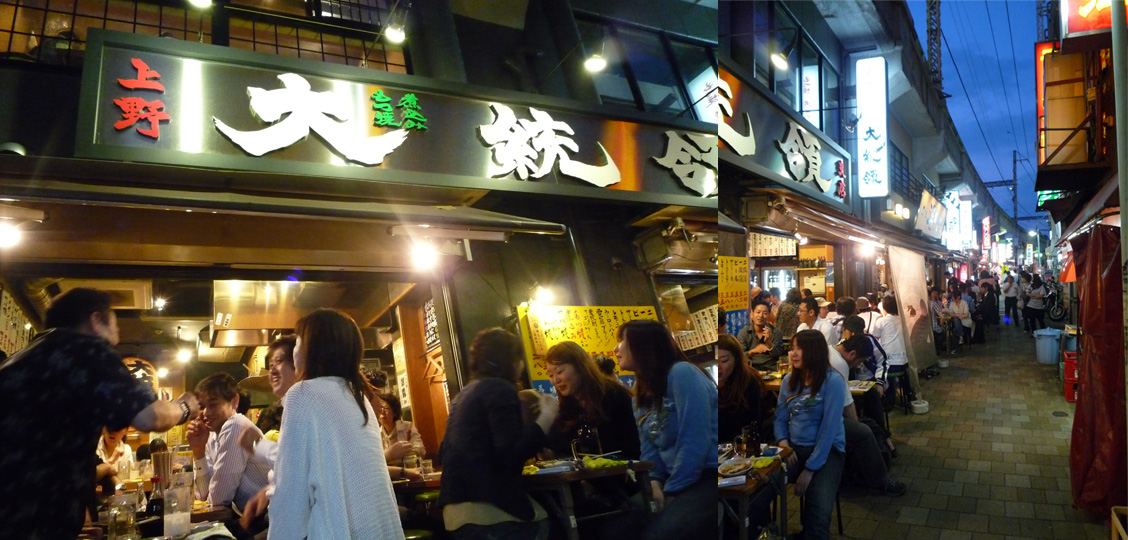
From there, we walked south to Ueno Park, famous for its springtime cherry blossoms and home to the Tokyo National Museum, The National Science Museum and The National Museum of Western Art.  Because it was getting dark, we decided to visit the museums another day and instead wandered to the Ueno station area, looking for dinner.  Under the train tracks, the nightlife was starting to get loud, and we found 大統領 (Daitouryou, or President) a bumpin’ little izakaya (bar that serves food) and had to stop.  There were no English menus or photos in sight, but the smells of the grill drew us in.

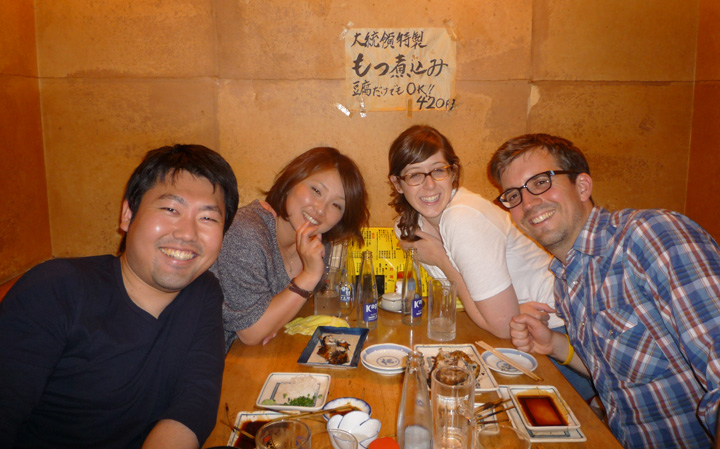
With tables spilling out onto the alley, smoke and beer and grilled meats aplenty, shouting patrons trying to converse over the rattle of the train above, Dan and I sat down and realized our task ahead — that we would actually have to order something.  Our method of choice thus far has been to blindly point at the menu, hope for a few winners, or at the very least for something identifiable.  In the super-packed restaurant, we were seated in a booth with another couple, and I’m sure my panic-stricken face was enough to clue them into our situation.  Tomo and Nana became fast friends as they helped us order (though I realized a language barrier still existed when we ended up with a plate of assorted grilled chicken innards, the house specialty, which surprisingly I enjoyed) and introduced us to shōchū (Japanese liquor tasting sort of like vodka).  I followed Nana’s lead and drank my shōchū with sour lemon soda.  Dan and Tomo drank their sweet potato shōchū (mojōchū) straight up.

As it turns out, Tomo and Nana were from an area an hour outside of Tokyo and were spending the day in the city.  They practiced their English, and we recited the few words we know in Japanese.  But really, our communication consisted of mostly hand waving, laughing and crazy gestures.  “What do you plan to do in Honolulu?”  Nana pretends to swim, and we all laugh.  “What sort of work do you do?”  Dan pretends to type on a keyboard, and again, laughter.  They recommend we visit Tokyo Disney Resort and Nana shrieks “Like it, like it! Love, love, love!” It was easy to see why we became such easy friends.

Well, that and the shōchū.